
VernodalolCAS# 65388-17-2 |
| Cas No. | 65388-17-2 | SDF | File under preparation. |
| PubChem ID | 442318 | Appearance | Powder |
| Formula | C20H24O8 | M.Wt | 392.4 |
| Type of Compound | Sesquiterpenoid | Storage | Desiccate at -20°C |
| Solubility | Soluble in Chloroform,Dichloromethane,Ethyl Acetate,DMSO,Acetone,etc. | ||
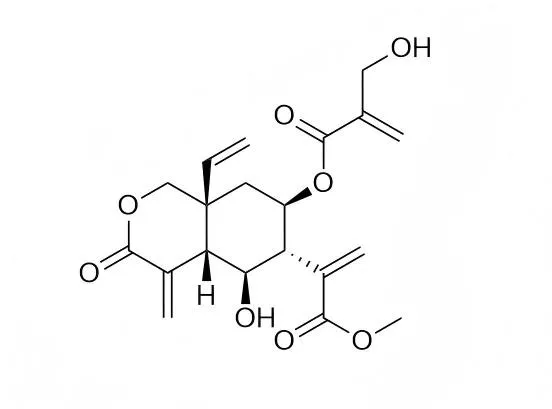
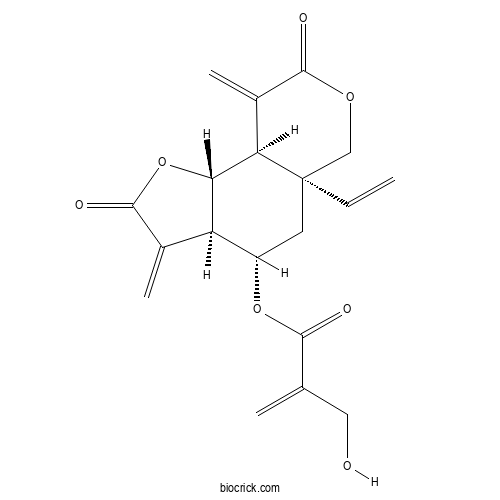
| Chemical Name | [(4aR,5R,6S,7S,8aR)-8a-ethenyl-5-hydroxy-6-(3-methoxy-3-oxoprop-1-en-2-yl)-4-methylidene-3-oxo-1,4a,5,6,7,8-hexahydroisochromen-7-yl] 2-(hydroxymethyl)prop-2-enoate | ||
| SMILES | COC(=O)C(=C)C1C(CC2(COC(=O)C(=C)C2C1O)C=C)OC(=O)C(=C)CO | ||
| Standard InChIKey | FZALQGCQQJLGKE-BBNZOYGDSA-N | ||
| Standard InChI | InChI=1S/C20H24O8/c1-6-20-7-13(28-17(23)10(2)8-21)14(11(3)18(24)26-5)16(22)15(20)12(4)19(25)27-9-20/h6,13-16,21-22H,1-4,7-9H2,5H3/t13-,14+,15+,16-,20+/m0/s1 | ||
| General tips | For obtaining a higher solubility , please warm the tube at 37 ℃ and shake it in the ultrasonic bath for a while.Stock solution can be stored below -20℃ for several months. We recommend that you prepare and use the solution on the same day. However, if the test schedule requires, the stock solutions can be prepared in advance, and the stock solution must be sealed and stored below -20℃. In general, the stock solution can be kept for several months. Before use, we recommend that you leave the vial at room temperature for at least an hour before opening it. |
||
| About Packaging | 1. The packaging of the product may be reversed during transportation, cause the high purity compounds to adhere to the neck or cap of the vial.Take the vail out of its packaging and shake gently until the compounds fall to the bottom of the vial. 2. For liquid products, please centrifuge at 500xg to gather the liquid to the bottom of the vial. 3. Try to avoid loss or contamination during the experiment. |
||
| Shipping Condition | Packaging according to customer requirements(5mg, 10mg, 20mg and more). Ship via FedEx, DHL, UPS, EMS or other couriers with RT, or blue ice upon request. | ||
Quality Control & MSDS
3D structure
Package In Stock
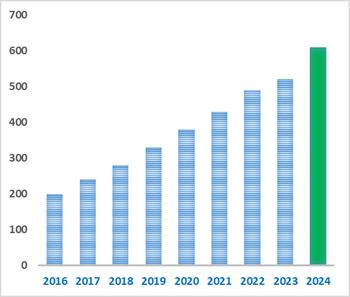
Number of papers citing our products

Vernodalol Dilution Calculator
Vernodalol Molarity Calculator
| 1 mg | 5 mg | 10 mg | 20 mg | 25 mg | |
| 1 mM | 2.5484 mL | 12.7421 mL | 25.4842 mL | 50.9684 mL | 63.7105 mL |
| 5 mM | 0.5097 mL | 2.5484 mL | 5.0968 mL | 10.1937 mL | 12.7421 mL |
| 10 mM | 0.2548 mL | 1.2742 mL | 2.5484 mL | 5.0968 mL | 6.371 mL |
| 50 mM | 0.051 mL | 0.2548 mL | 0.5097 mL | 1.0194 mL | 1.2742 mL |
| 100 mM | 0.0255 mL | 0.1274 mL | 0.2548 mL | 0.5097 mL | 0.6371 mL |
| * Note: If you are in the process of experiment, it's necessary to make the dilution ratios of the samples. The dilution data above is only for reference. Normally, it's can get a better solubility within lower of Concentrations. | |||||
- 2',3'-Dihydroxyasarone
Catalog No.:BCX2194
CAS No.:2061275-23-6
- Gymnoside VI
Catalog No.:BCX2193
CAS No.:899430-06-9
- Mulberroside E
Catalog No.:BCX2192
CAS No.:193483-94-2
- Trollisin I
Catalog No.:BCX2191
CAS No.:911063-04-2
- 6-[2,3-Dihydroxy-1-methoxy-3-methylbutyl]-7-methoxycoumarin)
Catalog No.:BCX2190
CAS No.:425370-70-3
- Ilexosapogenin A
Catalog No.:BCX2189
CAS No.:148031-70-3
- Tricin 4'-O-(erythro-beta-guaiacylglyceryl)ether
Catalog No.:BCX2188
CAS No.:1292294-32-6
- Angelol E
Catalog No.:BCX2187
CAS No.:83156-03-0
- 6-Methyl citrate
Catalog No.:BCX2186
CAS No.:26163-65-5
- Angelol D
Catalog No.:BCX2185
CAS No.:83199-39-7
- Verticilla-4(20),7,11-triene
Catalog No.:BCX2184
CAS No.:386223-19-4
- 7alpha-Hydroxydehydroabietic acid
Catalog No.:BCX2183
CAS No.:76235-98-8
- Hispidulin 7-O-glucuronide
Catalog No.:BCX2196
CAS No.:31105-76-7
- 11alpha,12beta-di-O-tigloyl-tenacigenin B
Catalog No.:BCX2197
CAS No.:154022-56-7
- Diosmetin 6-C-glucoside
Catalog No.:BCX2198
CAS No.:15822-82-9
- 2alpha,3beta,23-trihydroxyurs-20-en-28-oic acid
Catalog No.:BCX2199
CAS No.:948827-08-5
- 4-Methoxy-9,10-dihydrophenanthrene-2,7-di-O-beta-D-glucopyranoside
Catalog No.:BCX2200
CAS No.:1454585-37-5
- 3,3',4-Trimethoxylellagic acid
Catalog No.:BCX2201
CAS No.:124590-44-9
- Orientin 2''-O-(2'''-methylbutyrate)
Catalog No.:BCX2202
CAS No.:681152-44-3
- L-Tryptophan methyl ester
Catalog No.:BCX2203
CAS No.:4299-70-1
- Tenacissoside D
Catalog No.:BCX2204
CAS No.:107343-57-9
- 2'-Methoxymeranzin hydrate
Catalog No.:BCX2205
CAS No.:76996-30-0
- Isoswertisin 2''-O-(2'''-methylbutyrate)
Catalog No.:BCX2206
CAS No.:681152-39-6
- Gymnoside II
Catalog No.:BCX2207
CAS No.:899430-02-5
Luteolin and Vernodalol as Bioactive Compounds of Leaf and Root Vernonia amygdalina Extracts: Effects on alpha-Glucosidase, Glycation, ROS, Cell Viability, and In Silico ADMET Parameters.[Pubmed:37242783]
Pharmaceutics. 2023 May 19;15(5):1541.
The aqueous decoctions of Vernonia amygdalina (VA) leaves and roots are widely used in traditional African medicine as an antidiabetic remedy. The amount of luteolin and Vernodalol in leaf and root extracts was detected, and their role was studied regarding alpha-glucosidase activity, bovine serum albumin glycation (BSA), reactive oxygen species (ROS) formation, and cell viability, together with in silico absorption, distribution, metabolism, excretion, and toxicity (ADMET) properties. Vernodalol did not affect alpha-glucosidase activity, whereas luteolin did. Furthermore, luteolin inhibited the formation of advanced glycation end products (AGEs) in a concentration-dependent manner, whereas Vernodalol did not reduce it. Additionally, luteolin exhibited high antiradical activity, while Vernodalol demonstrated a lower scavenger effect, although similar to that of ascorbic acid. Both luteolin and Vernodalol inhibited HT-29 cell viability, showing a half-maximum inhibitory concentration (IC(50)) of 22.2 microM (-Log IC(50) = 4.65 +/- 0.05) and 5.7 microM (-Log IC(50) = 5.24 +/- 0.16), respectively. Finally, an in silico ADMET study showed that both compounds are suitable candidates as drugs, with appropriate pharmacokinetics. This research underlines for the first time the greater presence of Vernodalol in VA roots compared to leaves, while luteolin is prevalent in the latter, suggesting that the former could be used as a natural source of Vernodalol. Consequently, root extracts could be proposed for Vernodalol-dependent antiproliferative activity, while leaf extracts could be suggested for luteolin-dependent effects, such as antioxidant and antidiabetic effects.
Protective effect of Vernonia amygdalina Delile against doxorubicin-induced cardiotoxicity.[Pubmed:34401548]
Heliyon. 2021 Jun 29;7(7):e07434.
Doxorubicin has been used as an anticancer drug and has already indicated effective in the treatment of cancer. The incidence of cardiotoxicity due to doxorubicin was approximately 11%, resulting in the limited use of doxorubicin. Cardiac protection during doxorubicin therapy is needed because it can reduce the incidence of heart failure. Vernonia amygdalina (VA) is traditionally used by Indonesians as a traditional medicine and contains many secondary metabolites, including vernolide, Vernodalol, vernoamygdalin, vernolepin, luteolin, luteolin 7-O-beta-glucoronoside and luteolin 7-O-glucoside. The pharmacological activity of VA has been widely studied, including its antimalarial, antidiabetic, anticancer, hepatoprotective, nephroprotective, and antioxidant activities. This research aimed to determine the antioxidant 2,2-diphenyl-1-picrylhydrazyl (DPPH) scavenging activity, total phenol, total flavonoid, and cardioprotective effects of Vernonia Amygdalina. Negative control was only intraperitoneal injection of doxorubicin (20 mg/kgbw) on the eight day while quercetin (85 mg/kgbw) and ethanol extract of Vernonia amygdalina (EEVA) 100, 200, 400 mg/kgbw dose are orally administered for eight consecutive days. Both quercetin and EEVA groups were also injected with doxorubicin (20 mg/kgbw) on the same day. On the following day, rats were injected with ketamine HCL 75 mg/kgbw and were dissected for heart blood collected. The blood collected 3 ml from each rat was analyzed for biochemical parameters. The analyzed biochemical parameters were Aspartate transaminase (AST), Alanine transaminase (ALT), Ureum, Creatinine, Creatinine kinase-MB (CK-MB), Lactate dehydrogenase (LDH), Troponin T, Brain natriuretic peptide (BNP), and antioxidant parameter Superoxide Dismutase (SOD). The result showed that EEVA antioxidant activity was 40.51 +/- 4.89 mug/mL, total flavonoid was 3.79 +/- 0.61 mg QE/g extract, and total phenol was 281.575 +/- 1.069 mg GAE/g extract. Quercetin (85 mg/kgbw) and EEVA (400 mg/kgbw) reduce AST, ALT, Ureum, Creatinine, CK- MB, LDH, Troponin T, BNP significantly and increase rats' SOD level compared with negative control. So that, this study explicates that EEVA potentials as cardioprotective agent against doxorubicin by reducing biochemical parameters.
alpha-Glucosidase and advanced glycation end products inhibition with Vernonia amygdalina root and leaf extracts: new data supporting the antidiabetic properties.[Pubmed:33779755]
J Pharm Pharmacol. 2021 Aug 12;73(9):1240-1249.
OBJECTIVE: This study aims to investigate antidiabetic activity of several Vernonia amygdalina extracts to study their potential use in medicine. METHODS: Aqueous and ethanol extracts were obtained by maceration and Soxhlet extraction from roots and leaves of V. amygdalina. The extracts were tested as inhibitors of alpha-glucosidase activity and of advanced glycation end products (AGEs) formation. Further, radical scavenging activity was examined detecting the oxygen radical absorbance capacity, while the potential cytotoxicity of extracts was estimated with MTT assay. KEY FINDINGS: In aqueous and ethanol extracts, several polyphenolic compounds were identified; in detail, (-)-catechin and luteolin were found in leaf extracts, while caffeic acid, chlorogenic acid and the terpenoid Vernodalol were recognized in root extracts. Regarding antidiabetic activity, the aqueous root extracts efficiently inhibited alpha-glucosidase activity in a concentration-dependent manner (IC50 = 5.6 microg/ml and 39.8 microg/ml, respectively of macerated and Soxhlet extracts), whereas those obtained from leaves exhibited lower potency. Furthermore, AGEs formation was reduced by all V. amygdalina extracts starting from 10 microg/ml. CONCLUSIONS: The aqueous extracts of V. amygdalina roots obtained by maceration and Soxhlet extraction show remarkable anti-alpha-glucosidase activity, and all extracts have favourable antiglycation and antioxidant activities.
Covid-19 treatment: Investigation on the phytochemical constituents of Vernonia amygdalina as potential Coronavirus-2 inhibitors.[Pubmed:33619460]
Comput Toxicol. 2021 May;18:100161.
The upsurge in the current cases of COVID-19 poses a major threat on human health and population all over the globe. The emergence of new infectious diseases and increase in frequency of drug resistant viruses demand effective and novel therapeutic agents. In this study, we used bioinformatics approach to investigate the possible inhibitory potentials of phytochemical constituents of Vernonia amygdalina towards coronavirus-2 major protease. Pharmacodynamics, pharmacokinetics and toxicological profiles of the compounds were also examined using the pkCSM server. All the phytochemicals showed good binding affinity to the binding pocket of PDB ID 6LU7. It was observed that veronicoside A exhibited the highest binding affinity when compared to remdesivir, hydroxy-vernolide, vernodalin, Vernodalol, and vernolide. The amino acids LEU272, LEU287, GLY275, TYR237, LYS236, THR198, THR199, ARG131, and LYS5 were showed as the key residues for veronicoside A binding to human SARS-COV2 major protease. The Pharmacodynamics and pharmacokinetics results suggested that all the tested phytochemicals have significant drug likeness properties and they could be absorbed through the human intestine. Furthermore, all the tested phytochemicals are not hepatoxic and also exhibited non or relatively low toxic effects in human. Taken together, the results of this study indicated that all the tested phytochemicals are potential putative inhibitors of SARS-COV2 major protease with non or low toxicity effects. However, further experimental and clinical studies are needed to further explore their activities and validate their efficacies against COVID-19.
Vernodalol mediates antitumor effects in acute promyelocytic leukemia cells.[Pubmed:29434929]
Oncol Lett. 2018 Feb;15(2):2227-2235.
Acute promyelocytic leukemia (APL) remains a challenge to cure due to the side effects of cytotoxic chemotherapy and drug resistance. The present study demonstrated that Vernodalol, an active compound isolated from Centratherum anthelminticum, suppresses APL cell proliferation and induces cell cycle arrest in the G2/M phase through the upregulation of p21 and cell division cycle 25. In addition, Vernodalol induced cellular apoptosis via the mitochondrial pathway as observed by the cleavage of caspase-9 as well as the release of cytochrome c and Smac/DIABLO into the cytosol. A mechanistic study revealed that Vernodalol may exert its antitumor activity through the suppression of phosphoinositide 3-kinase/protein kinase B/mechanistic target of rapamycin signaling. In conclusion, Vernodalol may be developed as a potential therapeutic compound for the treatment of APL.
Sesquiterpene Lactones from Vernonia cinerascens Sch. Bip. and Their in Vitro Antitrypanosomal Activity.[Pubmed:29382040]
Molecules. 2018 Jan 27;23(2):248.
In the endeavor to obtain new antitrypanosomal agents, particularly sesquiterpene lactones, from Kenyan plants of the family Asteraceae, Vernonia cinerascens Sch. Bip. was investigated. Bioactivity-guided fractionation and isolation in conjunction with LC/MS-based dereplication has led to the identification of Vernodalol (1) and isolation of vernodalin (2), 11beta,13-dihydrovernodalin (3), 11beta,13-dihydrovernolide (4), vernolide (5), 11beta,13-dihydrohydroxyvernolide (6), hydroxyvernolide (7), and a new germacrolide type sesquiterpene lactone vernocinerascolide (8) from the dichloromethane extract of V. cinerascens leaves. Compounds 3-8 were characterized by extensive analysis of their 1D and 2D NMR spectroscopic and HR/MS spectrometric data. All the compounds were evaluated for their in vitro biological activity against bloodstream forms of Trypanosoma brucei rhodesiense and for cytotoxicity against the mammalian cell line L6. Vernodalin (2) was the most active compound with an IC(50) value of 0.16 microM and a selectivity index of 35. Its closely related congener 11beta,13-dihydrovernodalin (3) registered an IC(50) value of 1.1 microM and a selectivity index of 4.2.
Vernodalol enhances TRAIL-induced apoptosis in diffuse large B-cell lymphoma cells.[Pubmed:28467689]
Mol Carcinog. 2017 Oct;56(10):2190-2199.
Tumor necrosis factor (TNF)-related apoptosis-inducing ligand (TRAIL) is a potent anti-tumor agent that triggers apoptosis in cells from multiple types of carcinoma but not in normal cells. However, diverse mechanisms are associated with insensitivity to TRAIL in various cancers. TRAIL efficacy may be enhanced by combining TRAIL with a sensitizer. In this study, Vernodalol, a sesquiterpene lactone, sensitized diffuse large B-cell lymphoma (DLBCL) cells to TRAIL-induced apoptosis. Vernodalol increased the expression of death receptor (DR) 5, and silencing of DR5 with a small interfering RNA (siRNA) reduced the effect of Vernodalol on TRAIL-mediated apoptosis. Additionally, Vernodalol up-regulated the expression of CCAAT/enhancer-binding protein (C/EBP) homologous protein (CHOP), a transcription factor. Inhibition of CHOP with a siRNA diminished DR5 expression and Vernodalol-induced sensitization to the TRAIL treatment. In addition, a c-Jun N-terminal kinase (JNK) inhibitor blocked the Vernodalol-induced up-regulation of DR5, indicating that the effect depended on JNK activation. Furthermore, the down-regulation of induced myeloid leukaemia cell differentiation protein (Mcl-1) played an important role in Vernodalol/TRAIL-induced apoptosis, as Mcl-1 overexpression prevented this apoptotic effect. Moreover, the Vernodalol/TRAIL combination inhibited tumor growth in a xenograft model. Based on our results, Vernodalol enhanced TRAIL-induced apoptosis by down-regulating Mcl-1 and up-regulating DR5, and the effects of DR5 depended on JNK activation and CHOP induction. Therefore, combining TRAIL with Vernodalol, a naturally occurring agent, may represent a promising therapeutic approach for DLBCL.
Anti-Trypanosomatid Elemanolide Sesquiterpene Lactones from Vernonia lasiopus O. Hoffm.[Pubmed:28397756]
Molecules. 2017 Apr 8;22(4):597.
Sleeping sickness or human African trypanosomiasis (HAT) is a neglected tropical disease (NTD) threatening millions of peoples' lives with thousands infected. The disease is endemic in poorly developed regions of sub-Saharan Africa and is caused by the kinetoplastid "protozoan" parasite Trypanosoma brucei. The parasites are transmitted to humans through bites of infected tsetse flies of the genus Glossina. The few available drugs for treatment of this disease are highly toxic, difficult to administer, costly and unavailable to poor rural communities bearing the major burden of this infection. Therefore, the search for new efficacious, safe and affordable drugs is of high importance. Vernonia lasiopus O. Hoffm., an indigenous African plant of the Asteraceae family, has been extensively reported to be used ethno-medicinally as a treatment for malaria. Its crude extracts obtained with solvents of different polarity were screened in vitro for anti-protozoal activity and the dichloromethane extract was found to be particularly active against Trypanosoma brucei rhodesiense (IC(50) = 0.17 microg/mL). Bioassay-guided chromatographic fractionation of the dichloromethane extract led to the isolation and identification of six elemanolide type sesquiterpene lactones: 8-desacylvernolide, vernolepin, vernomenin, Vernodalol, vernodalin and 11,13-dihydrovernodalin. All these elemanolide sesquiterpene lactones showed in vitro anti-trypanosomal activity. They were also tested for cytotoxicity against mammalian cells (L6 cell line). Vernolepin, the main component in the extract, was also the most potent with an IC(50) value of 0.05 microg/mL against T.b. rhodesiense trypomastigotes. This compound showed a selectivity index of 14.5, which makes it an interesting candidate for in vivo tests and determination of its mechanism of action.
Plasmodium transmission blocking activities of Vernonia amygdalina extracts and isolated compounds.[Pubmed:26208861]
Malar J. 2015 Jul 25;14:288.
BACKGROUND: Medicinal plants are a validated source for discovery of new leads and standardized herbal medicines. The aim of this study was to assess the activity of Vernonia amygdalina leaf extracts and isolated compounds against gametocytes and sporogonic stages of Plasmodium berghei and to validate the findings on field isolates of Plasmodium falciparum. METHODS: Aqueous (Ver-H2O) and ethanolic (Ver-EtOH) leaf extracts were tested in vivo for activity against sexual and asexual blood stage P. berghei parasites. In vivo transmission blocking effects of Ver-EtOH and Ver-H2O were estimated by assessing P. berghei oocyst prevalence and density in Anopheles stephensi mosquitoes. Activity targeting early sporogonic stages (ESS), namely gametes, zygotes and ookinetes was assessed in vitro using P. berghei CTRPp.GFP strain. Bioassay guided fractionation was performed to characterize V. amygdalina fractions and molecules for anti-ESS activity. Fractions active against ESS of the murine parasite were tested for ex vivo transmission blocking activity on P. falciparum field isolates. Cytotoxic effects of extracts and isolated compounds vernolide and Vernodalol were evaluated on the human cell lines HCT116 and EA.hy926. RESULTS: Ver-H2O reduced the P. berghei macrogametocyte density in mice by about 50% and Ver-EtOH reduced P. berghei oocyst prevalence and density by 27 and 90%, respectively, in An. stephensi mosquitoes. Ver-EtOH inhibited almost completely (>90%) ESS development in vitro at 50 mug/mL. At this concentration, four fractions obtained from the ethylacetate phase of the methanol extract displayed inhibitory activity >90% against ESS. Three tested fractions were also found active against field isolates of the human parasite P. falciparum, reducing oocyst prevalence in Anopheles coluzzii mosquitoes to one-half and oocyst density to one-fourth of controls. The molecules and fractions displayed considerable cytotoxicity on the two tested cell-lines. CONCLUSIONS: Vernonia amygdalina leaves contain molecules affecting multiple stages of Plasmodium, evidencing its potential for drug discovery. Chemical modification of the identified hit molecules, in particular Vernodalol, could generate a library of druggable sesquiterpene lactones. The development of a multistage phytomedicine designed as preventive treatment to complement existing malaria control tools appears a challenging but feasible goal.
Poly-Electrophilic Sesquiterpene Lactones from Vernonia amygdalina: New Members and Differences in Their Mechanism of Thiol Trapping and in Bioactivity.[Pubmed:26115003]
J Nat Prod. 2015 Jul 24;78(7):1618-23.
In addition to known compounds, the leaves of Vernonia amygdalina afforded the new sesquiterpene lactones 14-O-methylvernolide (2), 3'-deoxyVernodalol (6), and vernomygdalin (8). These and related compounds were evaluated for modulation of a series of thiol trapping-sensitive transcription factors (NF-kappaB, STAT3, and Nrf2), involved in the maintenance of the chronic inflammatory condition typical of human degenerative diseases. Vernolide (1) emerged as a potent inhibitor of STAT3 and NF-kappaB and showed cytostatic activity toward the prostate cancer cell line DU45, arresting the cell cycle at the S phase. The exomethylene lactones are characterized by multiple Michael acceptor sites, as exemplified by vernolide (1) and Vernodalol (5). By using the nuclear magnetic resonance-based cysteamine assay, the most reactive thiophilic site could be identified in both compounds, and competitive experiments qualified vernolide (1) as being more thiophilic than Vernodalol (5), in agreement with the results of the pharmacological assays.
Anti-nociceptive activity of seed extract of Vernonia anthelmintica willd.[Pubmed:26045382]
Pak J Pharm Sci. 2014 Nov;27(6 Spec No.):2177-81.
Vernonia anthelmintica is commonly known as kali ziri. Its seeds are used for several therapeutical purposes. Its seeds contain many constituents of medicinal importance as vernodlin, Vernodalol, and vernolic acid. It is commonly used psoriasis and leucoderma or white leprosy. It is potent wormicidal agent. The present study was conducted on seed's extract of V. anthelmintica to determine its analgesic potency. The activity was conducted on mice by using acetic acid induced writhes,hot plate method and by tail flick method using water bath. The results of the writhing test were highly significant and comparable with Aspirin, which produced 26 and 20 writhes. The percentage of inhibition of writhes with the two doses of crude extract was 65.45% and 64.28% at 300mg/kg, while 83.63% and 71.42% at 500mg/kg, where as with Aspirin it was 52.72% and 28.57% in first and second phase respectively. Hot plate and tail flick method also indicated that vernonia has potent analgesic activity. The drug can be utilized as anti-nociceptive agent.
Antimalarial sesquiterpene lactones from Distephanus angulifolius.[Pubmed:19298984]
Phytochemistry. 2009 Mar;70(5):601-7.
Combined use of bioassay-guided fractionation based on in vitro antiplasmodial assay and dereplication based on HPLC-PDA-MS-SPE-NMR led to isolation of (6S,7R,8S)-14-acetoxy-8-[2-hydroxymethylacrylat]-15-helianga-1(10),4,11(13)-trien-15-al-6,12-olid and (5R,6R,7R,8S,10S)-14-acetoxy-8-[2-hydroxymethylacrylat]-elema-1,3,11(13)-trien-15-al-6,12-olid, along with Vernodalol, vernodalin, and 11,13beta-dihydroxyvernodalin from extract of Distephanus angulifolius. All compounds were identified by spectroscopic methods, including 1D and 2D homo- and heteronuclear NMR experiments. The isolated compounds showed IC(50) values in the range 1.6-3.8 microM and 2.1-4.9 microM against chloroquine sensitive D10 and chloroquine resistant W2 Plasmodium falciparum strains, respectively.
Bioactive sesquiterpene lactones from the leaves of Vernonia amygdalina.[Pubmed:16458461]
J Ethnopharmacol. 2006 Jun 15;106(1):117-20.
Phytochemical analysis of the leaves of Vernonia amygdalina yielded two known sesquiterpene lactones: vernolide and Vernodalol. The two compounds were tested by agar dilution method against 10 bacteria strains and 5 fungi species. Both compounds exhibited a significant bactericidal activity against five Gram positive bacteria while lacking efficacy against the Gram negative strains. In the antifungal test, while vernolides exhibited high activity with LC(50) values of 0.2, 0.3 and 0.4 mg/ml against Penicillium notatum, Aspergillus flavus, Aspergillus niger and Mucor hiemalis, respectively, Vernodalol showed moderate inhibitions against Aspergillus flavus, Penicillium notatum and Aspergillus niger with LC(50) values of 0.3, 0.4 and 0.5 mg/ml, respectively. Both compounds were ineffective against Fusarium oxysporum, a microbe known to be highly resistant to chemical agents. However, the antimicrobial results of this study correspond positively with the claimed ethnomedical uses of the leaves of Vernonia amygdalina in the treatment of various infectious diseases.
In vitro cytotoxic elemanolides from Vernonia lasiopus.[Pubmed:12624825]
Planta Med. 2003 Feb;69(2):164-6.
Two new elemanolides, epiVernodalol and lasiopulide, were isolated after chromatographic separation of the alcoholic extract of the dried aerial parts of the Vernonia lasiopus. These elemanolides are new C-10 epimers of the sesquiterpene lactones Vernodalol and demethylacroylated Vernodalol isolated from other species of Vernonia. Both elemanolides showed in vitro cytotoxicity against human cancer cell lines in culture. This is the first report of isolation and cytotoxic activity of the two elemanolides from V. lasiopus.

Calcutta University

University of Minnesota

University of Maryland School of Medicine

University of Illinois at Chicago

The Ohio State University

University of Zurich

Harvard University

Colorado State University

Auburn University

Yale University

Worcester Polytechnic Institute

Washington State University

Stanford University

University of Leipzig

Universidade da Beira Interior
The Institute of Cancer Research

Heidelberg University

University of Amsterdam

University of Auckland

TsingHua University

The University of Michigan

Miami University

DRURY University

Jilin University

Fudan University

Wuhan University

Sun Yat-sen University

Universite de Paris

Deemed University

Auckland University

The University of Tokyo

Korea University