Cancer Research
Cancer is a term used to define a group of diseases in which abnormal cells divide without control, are able to invade neighboring tissues/organs and metastasize. Cancer has been characterized by six hallmarks; self sufficiency in proliferative growth signals, insensitivity to growth inhibitors, evasion of apoptosis, limitless replicative potential, ability to develop blood vessels (angiogenesis), and tissue invasion and metastasis.
Cancer Research Products Areas
Products for Cancer Research - Page 14
- Cat.No. Product Name Information/Activity
-
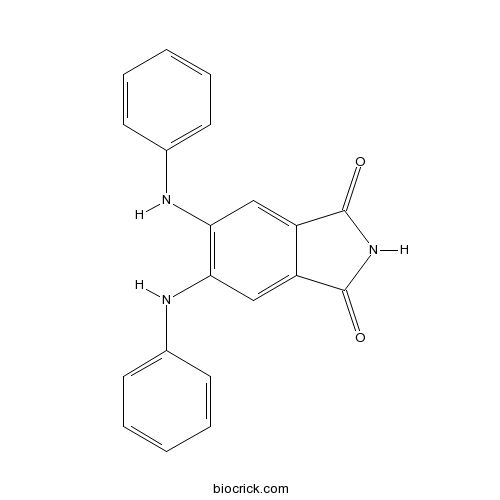
BCC6722
AG 494
Potent EGFR-kinase inhibitor
-
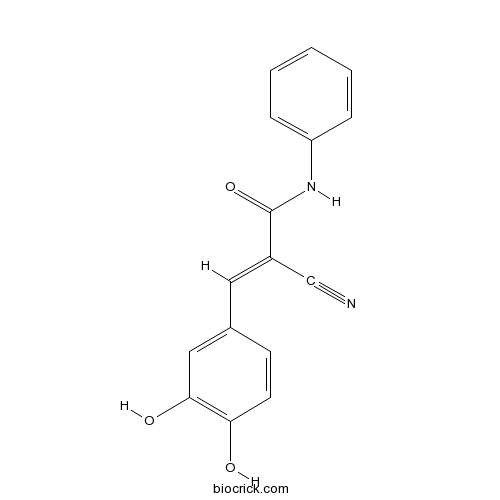
BCC6721
AG 555
AG 555, a potent antiretroviral drug, is a potent and selective inhibitor of EGFR and blocks Cdk2 activation.
-
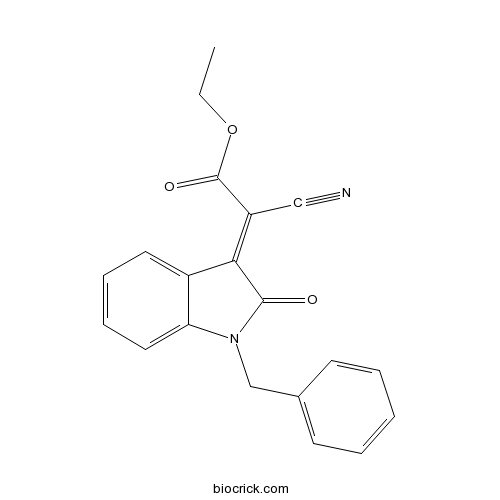
BCC6720
AG 556
EGFR-kinase inhibitor
-
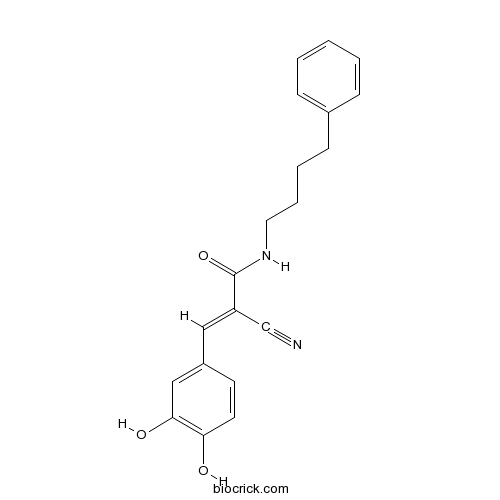
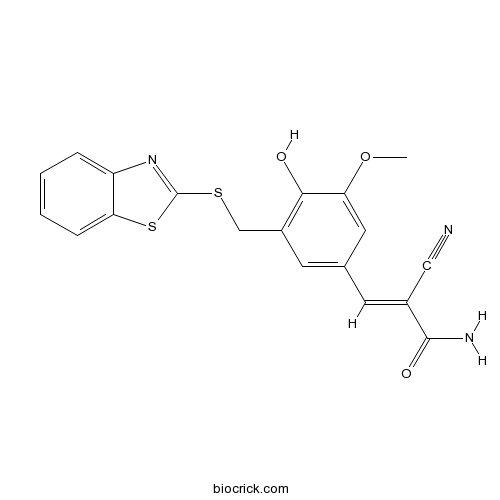
BCC7113
AG 825
AG-825 (Tyrphostin AG-825) is a selective and ATP-competitive ErbB2 inhibitor which suppresses tyrosine phosphorylation, with an IC50 of 0.35 μM. AG-825 displays anti-cancer activity. AG825 significantly accelerates apoptosis of human neutrophils. AG-825 is a potential agent for overcoming Mn-induced neurotoxicity or AD development.
-
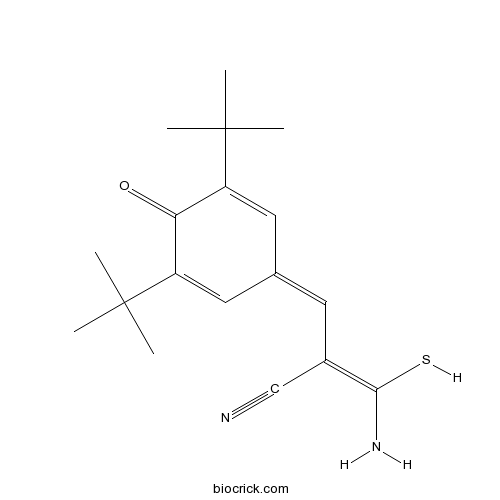
BCC4514
Tyrphostin AG 879
Tyrphostin AG 879 (AG 879) is a tyrosine kinase inhibitor that inhibits TrKA phosphorylation (IC50 of 10 μM), but not TrKB and TrKC. Tyrphostin AG 879 is also a selective ErbB2 tyrosine kinase inhibitor with an IC50 of 1 μM, and has at least 500-fold higher selectivity to ErbB2 than EGFR. Tyrphostin AG 879 has anticancer activity.
-
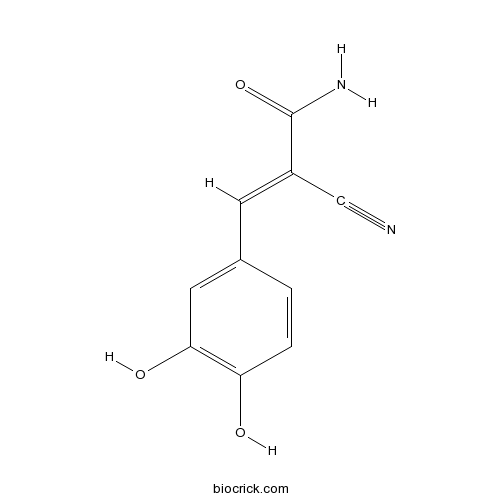
BCC6667
AG 99
(E)-AG 99 ((E)-Tyrphostin 46; (E)-Tyrphostin AG 99) is a potent EGFR inhibitor.
-
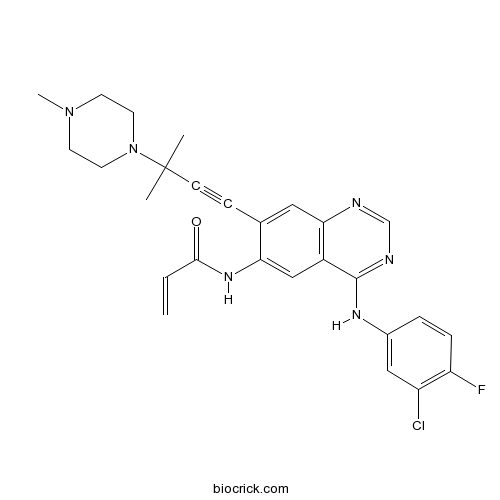
BCC5120
AV-412 free base
AV-412 free base (MP-412 free base) is an EGFR inhibitor with IC50s of 0.75, 0.5, 0.79, 2.3, 19 nM for EGFR, EGFRL858R, EGFRT790M, EGFRL858R/T790M and ErbB2, respectively.
-
BCC7356
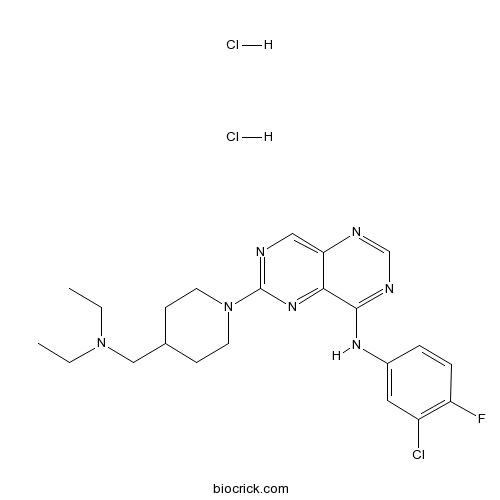
BIBU 1361 dihydrochloride
Selective inhibitor of EGFR-kinase
-
BCC1449
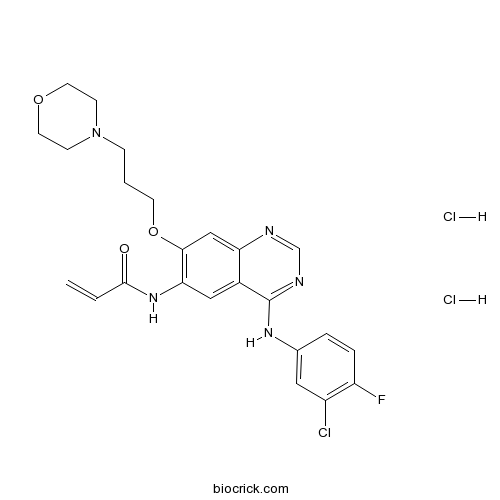
Canertinib dihydrochloride
Canertinib dihydrochloride (CI-1033 dihydrochloride) is a potent and irreversible EGFR inhibitor; inhibits cellular EGFR and ErbB2 autophosphorylation with IC50s of 7.4 and 9 nM.
-
BCC7667
CGP 52411
CGP52411 (DAPH) is a high selective, potent, orally active and ATP-competitive EGFR inhibitor with an IC50 of 0.3 μM. CGP52411 blocks the toxic influx of Ca2+ ions into neuronal cells, and dramatic inhibits and reverses the formation of β-amyloid (Aβ42) fibril aggregates associated with Alzheimer's disease.