Myocardial Infarction Research
Myocardial infarction (MI) - more commonly referred to as a heart attack - is an acute event caused by the interruption of blood supply to regions of the heart, leading to myocardial necrosis. Infarction of a substantial area of the myocardium can disrupt normal conductance of the heart, leading to cardiac arrest.In the majority of cases, an MI is immediately preceded by the presence of an occlusive thrombus within a coronary artery, blocking blood flow to the downstream tissue. The most common cause of an occlusive thrombus within a coronary artery is the rupture of an atherosclerotic plaque. However, the occlusion of a coronary artery may also result from coronary embolism. This can occur in patients following stent placement, angioplasty, and coronary artery bypass grafting.
Myocardial Infarction Research Products Targets
- Adenosine A2B Receptor (7)
- Adenosine A2A Receptor (11)
- Voltage-gated Sodium (NaV) Channel (30)
- Voltage-gated Potassium (KV) Channel (38)
- Voltage-gated Calcium Channel (CaV) (38)
- Cell Adhesion Molecule (21)
- Others (10)
- Cyclooxygenase (24)
- Epithelial Sodium Channel (3)
- STIM-Orai Channel (4)
- Ryanodine Receptor (6)
- Angiotensin-Converting Enzyme (8)
- IP3 Receptor (2)
- Adenosine A3 Receptor (8)
- Adenosine A1 Receptor (12)
- Acid-Sensing Ion Channel (3)
- Calcium-Activated Potassium (KCa) Channel (19)
- Inward Rectifier Potassium (Kir) Channel (21)
- NO donors and precursors (9)
- nNOS (5)
- iNOS (11)
- eNOS (1)
- Stem Cell Differentiation (54)
- Delta opioid receptor (16)
- Cathepsin (9)
- Adrenergic β3 Receptor (12)
- Adrenergic β2 Receptor (6)
- Adrenergic β1 Receptor (7)
- Prostanoid Receptor (24)
Products for Myocardial Infarction Research - Page 34
- Cat.No. Product Name Information/Activity
-
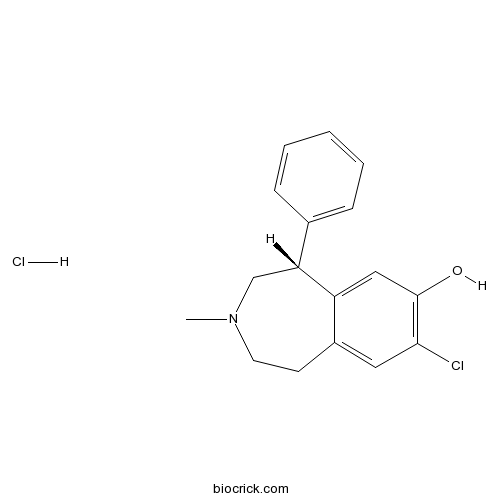
BCC6849
SCH 23390 hydrochloride
SCH-23390 hydrochloride (R-(+)-SCH-23390 hydrochloride) is a potent and selective dopamine D1-like receptor antagonist with Kis of 0.2 nM and 0.3 nM for the D1 and D5 receptor, respectively. SCH-23390 hydrochloride is a potent and high efficacy human 5-HT2C receptor agonist with a Ki of 9.3 nM. SCH-23390 hydrochloride also binds with high affinity to the 5-HT2 and 5-HT1C receptors. SCH-23390 hydrochloride inhibits G protein-coupled inwardly rectifying potassium (GIRK) channels with an IC50 of 268 nM.
-
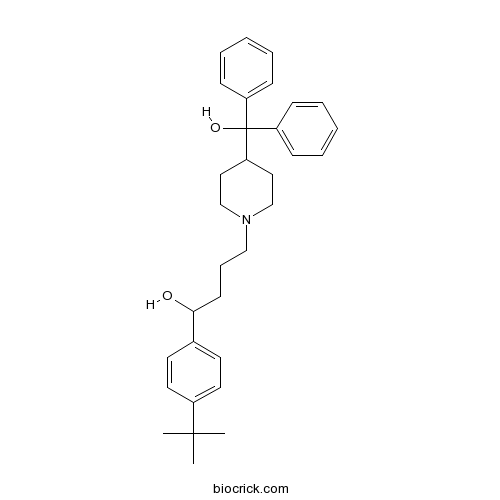
BCC3866
Terfenadine
Terfenadine ((±)-Terfenadine) is a potent open-channel blocker of hERG with an IC50 of 204 nM. Terfenadine, an H1 histamine receptor antagonist, acts as a potent apoptosis inducer in melanoma cells through modulation of Ca2+ homeostasis. Terfenadine induces ROS-dependent apoptosis, simultaneously activates Caspase-4, -2, -9.
-
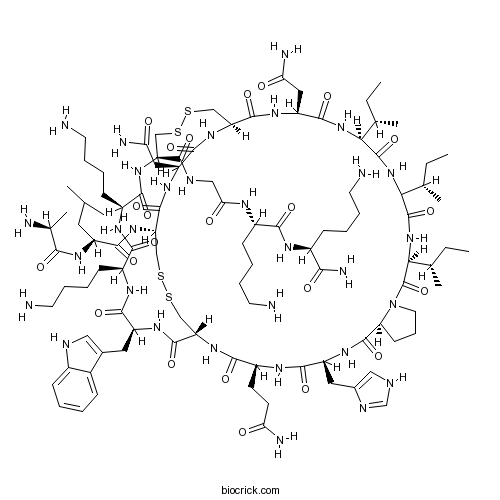
BCC5740
Tertiapin-Q
252198-49-5
-
BCC6126
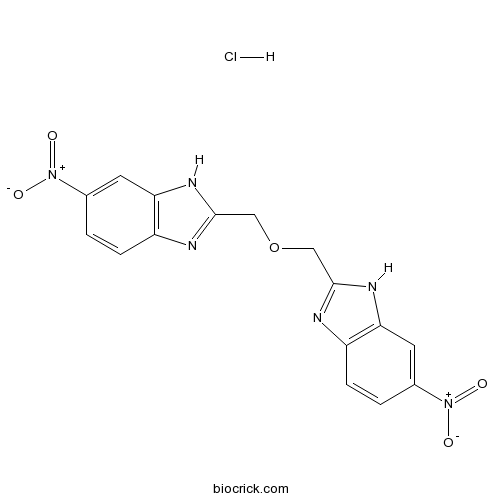
VU 591 hydrochloride
VU591 hydrochloride is a potent, selective renal outer medullary potassium channel (ROMK or Kir1.1) inhibitor, with an IC50 of 0.24 μM.
-
BCC4456
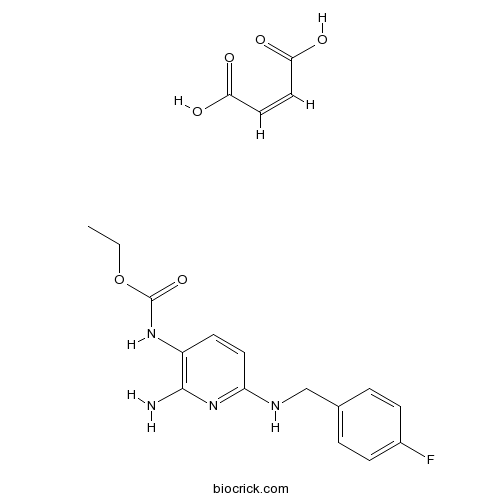
Flupirtine maleate
Flupirtine Maleate(D 9998) is a selective neuronal potassium channel opener that also has NMDA receptor antagonist properties.
-
BCC7911
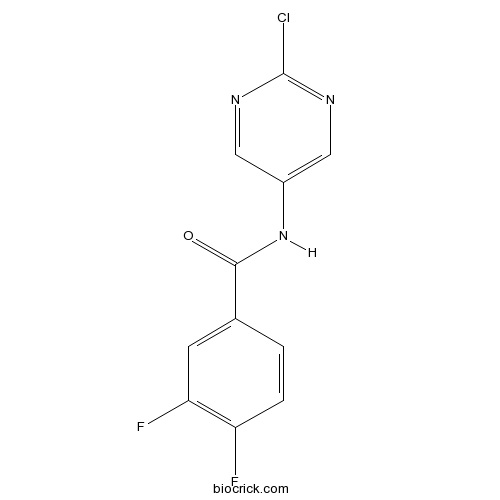
ICA 069673
ICA-069673 is a KCNQ2/Q3 potassium channel activator with an IC50 of 0.69 μM.
-
BCC6338
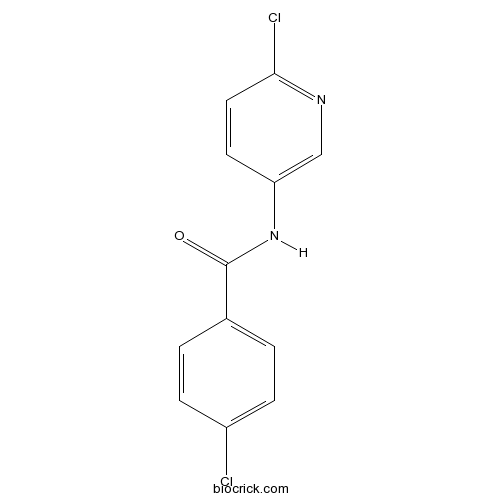
ICA 110381
ICA 110381 (Compound 16) is a KCNQ2/Q3 potassium channel opener for the treatment of epilepsy. ICA 110381 is a KCNQ2/Q3 agonist (EC50=0.38 μM) as well as KCNQ1 antagonist (IC50=15 μM).
-
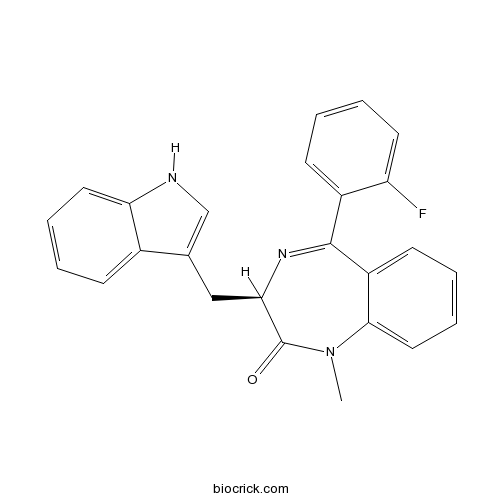
BCC7445
L-364,373
103342-82-1
-
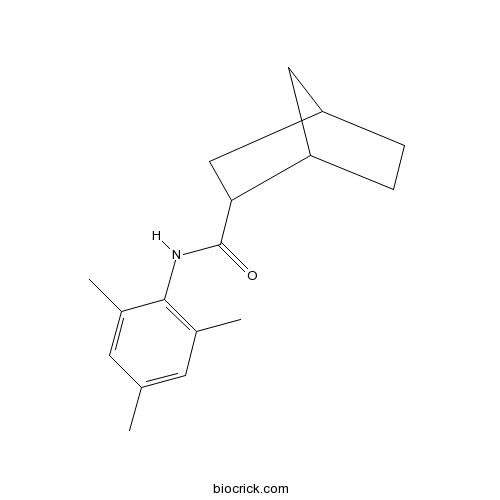
BCC6213
ML 213
ML213 is a selective activator of Kv7.2 and Kv7.4 channels, enhances Kv7.2 and Kv7.4 channels with EC50s of 230 and 510 nM, respectively.
-
BCC7976
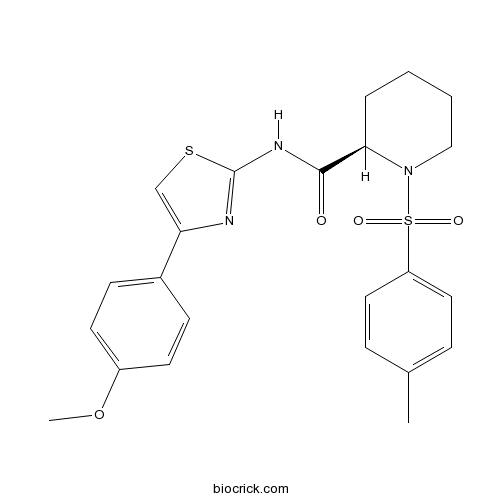
ML 277
ML277(CID53347902) is a novel, potent and selective K(v)7.1 (KCNQ1) potassium channel activator with EC50 of 270 nM.