
VernodalinCAS# 21871-10-3 |
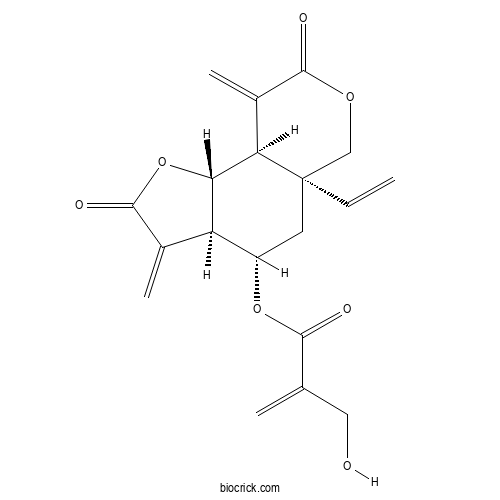
| Cas No. | 21871-10-3 | SDF | File under preparation. |
| PubChem ID | 179375 | Appearance | Powder |
| Formula | C19H20O7 | M.Wt | 360.4 |
| Type of Compound | Sesquiterpenoids | Storage | Desiccate at -20°C |
| Solubility | Soluble in Chloroform,Dichloromethane,Ethyl Acetate,DMSO,Acetone,etc. | ||
| Chemical Name | [(3aR,4S,5aR,9aR,9bR)-5a-ethenyl-3,9-dimethylidene-2,8-dioxo-3a,4,5,6,9a,9b-hexahydrofuro[2,3-f]isochromen-4-yl] 2-(hydroxymethyl)prop-2-enoate | ||
| SMILES | C=CC12CC(C3C(C1C(=C)C(=O)OC2)OC(=O)C3=C)OC(=O)C(=C)CO | ||
| Standard InChIKey | ZSXNBLOPYIJLQV-WSVVRNJXSA-N | ||
| Standard InChI | InChI=1S/C19H20O7/c1-5-19-6-12(25-16(21)9(2)7-20)13-10(3)18(23)26-15(13)14(19)11(4)17(22)24-8-19/h5,12-15,20H,1-4,6-8H2/t12-,13+,14+,15-,19+/m0/s1 | ||
| General tips | For obtaining a higher solubility , please warm the tube at 37 ℃ and shake it in the ultrasonic bath for a while.Stock solution can be stored below -20℃ for several months. We recommend that you prepare and use the solution on the same day. However, if the test schedule requires, the stock solutions can be prepared in advance, and the stock solution must be sealed and stored below -20℃. In general, the stock solution can be kept for several months. Before use, we recommend that you leave the vial at room temperature for at least an hour before opening it. |
||
| About Packaging | 1. The packaging of the product may be reversed during transportation, cause the high purity compounds to adhere to the neck or cap of the vial.Take the vail out of its packaging and shake gently until the compounds fall to the bottom of the vial. 2. For liquid products, please centrifuge at 500xg to gather the liquid to the bottom of the vial. 3. Try to avoid loss or contamination during the experiment. |
||
| Shipping Condition | Packaging according to customer requirements(5mg, 10mg, 20mg and more). Ship via FedEx, DHL, UPS, EMS or other couriers with RT, or blue ice upon request. | ||
Quality Control & MSDS
3D structure
Package In Stock
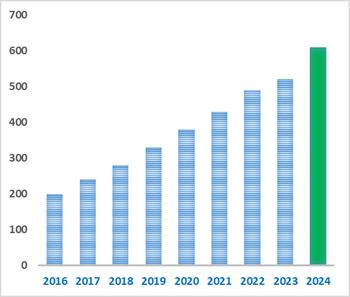
Number of papers citing our products

Vernodalin Dilution Calculator
Vernodalin Molarity Calculator
| 1 mg | 5 mg | 10 mg | 20 mg | 25 mg | |
| 1 mM | 2.7747 mL | 13.8735 mL | 27.7469 mL | 55.4939 mL | 69.3674 mL |
| 5 mM | 0.5549 mL | 2.7747 mL | 5.5494 mL | 11.0988 mL | 13.8735 mL |
| 10 mM | 0.2775 mL | 1.3873 mL | 2.7747 mL | 5.5494 mL | 6.9367 mL |
| 50 mM | 0.0555 mL | 0.2775 mL | 0.5549 mL | 1.1099 mL | 1.3873 mL |
| 100 mM | 0.0277 mL | 0.1387 mL | 0.2775 mL | 0.5549 mL | 0.6937 mL |
| * Note: If you are in the process of experiment, it's necessary to make the dilution ratios of the samples. The dilution data above is only for reference. Normally, it's can get a better solubility within lower of Concentrations. | |||||
- Euphorbia factor L11
Catalog No.:BCX2216
CAS No.:850560-45-1
- 8-Acetyl-9-hydroxy-3-methoxy-7-methyl-1-phenalenon
Catalog No.:BCX2215
CAS No.:2193052-99-0
- cis-Melilotoside
Catalog No.:BCX2214
CAS No.:2446-60-8
- Batatasin III-3-O-beta-D-glucoside
Catalog No.:BCX2213
CAS No.:189302-75-8
- Methyl gymnoside I
Catalog No.:BCX2212
CAS No.:1454585-33-1
- Cronupapin
Catalog No.:BCX2211
CAS No.:143572-66-1
- 5-Epikarelinine
Catalog No.:BCX2210
CAS No.:2102716-91-4
- Pleionoside G
Catalog No.:BCX2209
CAS No.:2292159-78-3
- Tricin 4'-O-(threo-beta-guaiacylglyceryl)ether
Catalog No.:BCX2208
CAS No.:369390-51-2
- Gymnoside II
Catalog No.:BCX2207
CAS No.:899430-02-5
- Isoswertisin 2''-O-(2'''-methylbutyrate)
Catalog No.:BCX2206
CAS No.:681152-39-6
- 2'-Methoxymeranzin hydrate
Catalog No.:BCX2205
CAS No.:76996-30-0
- Isoswertisin
Catalog No.:BCX2218
CAS No.:6980-40-1
- Puerarin 6''-O-glucoside
Catalog No.:BCX2219
CAS No.:168060-90-0
- Higenamine 4'-O-beta-D-glucoside
Catalog No.:BCX2220
CAS No.:1440545-91-4
- 15R-Kirenol (ent-2alpha,15R,16,19-tetrahydroxypimar-8(14)-ene)
Catalog No.:BCX2221
CAS No.:1622876-96-3
- 14-Acetoxy-12-senecioyloxytetradeca-2E,8E,10E-trien-4,6-diyn-1-ol
Catalog No.:BCX2222
CAS No.:113269-37-7
- 9S,12S,13S-Trihydroxy-10E-octadecenoate
Catalog No.:BCX2223
CAS No.:97134-11-7
- (S)-7-O-Methylpeucedanol 3'-O-beta-D-glucopyranoside
Catalog No.:BCX2224
CAS No.:214627-06-2
- Hopantenic acid (Dexpanthenol Impurity 4)
Catalog No.:BCX2225
CAS No.:49831-65-4
- Leptodactylone
Catalog No.:BCX2226
CAS No.:61899-44-3
- Byakangelicin-3''-ethyl ether
Catalog No.:BCX2227
CAS No.:68047-30-3
- erythro-1-C-Syringylglycerol 4-O-beta-D-glucopyranoside
Catalog No.:BCX2228
CAS No.:942304-07-6
- 2,3-Dihydroxy-2,3-dihydrosqualene (NSC837085)
Catalog No.:BCX2229
CAS No.:915385-29-4
Vernodalin and Gymnanthemum extensum Crude Extracts Exhibit In Vitro Anticancer Activity with Differential Regulation of Cancer-Associated Signaling Proteins in Breast and Ovarian Cancer Cells.[Pubmed:42351758]
Biomedicines. 2026 Jun 11;14(6):1331.
Background/Objectives: Vernodalin (VD) and crude extracts from Gymnanthemum extensum leaves have previously demonstrated anticancer activity; however, their underlying molecular effects remain incompletely understood. This study investigated the anticancer activities of VD and G. extensum extracts and characterized their associated molecular responses in breast (MDA-MB-231) and ovarian (A2780) cancer cells. Methods: G. extensum leaves were extracted with dichloromethane and ethyl acetate to obtain DEGE and EAGE, respectively. VD was isolated from EAGE and characterized by (1)H-NMR and HPLC. Phytochemical profiles of the extracts were analyzed by GC-MS and HPLC. Cytotoxicity, clonogenic survival, cell cycle progression, migration, and protein expression were evaluated using MTT assay, colony formation assay, flow cytometry, wound healing assay, and Western blotting. Results: GC-MS analysis revealed distinct phytochemical compositions between DEGE and EAGE, although both extracts contained high levels of neophytadiene and phytol. VD, DEGE, and EAGE inhibited cell proliferation and migration in both cancer cell lines. VD suppressed proteins associated with cancer progression, including SMYD3, BRAF, MELK, FOXM1, Cyclin B1, MDR1/ABCB1, and MMP-9, with molecular responses differing between MDA-MB-231 and A2780 cells. DEGE and EAGE exhibited molecular regulatory patterns distinct from those of purified VD, suggesting contributions from multiple phytochemical constituents. Conclusions: VD and G. extensum crude extracts exhibit significant in vitro anticancer activity against breast and ovarian cancer cells and induce distinct molecular responses. The differential effects of DEGE and EAGE may be attributable to differences in their phytochemical constituents.
Investigating the effects and mechanisms of Vernonia anthelmintica (L.) willd., seed extracts on melanogenesis and vitiligo treatment based on multi-omics and network pharmacology.[Pubmed:40967490]
J Ethnopharmacol. 2026 Jan 30;355(Pt A):120528.
ETHNOPHARMACOLOGICAL RELEVANCE: Vitiligo is a depigmentation disorder characterized by the loss of functional melanocytes, leading to skin and/or hair depigmentation. Vernonia anthelmintica (L.) Willd seed extracts have been traditionally used to treat pigmentation disorders in Central Asia. However, its pharmacological mechanism for vitiligo is still unknown. AIMS OF THE STUDY: In a previous study, we isolated the Extracts (encoded as CAM-Y7) from the Vernonia anthelmintica (L.) Willd seed. This research aims to understand the molecular basis of hyperpigmentation triggered by CAM-Y7. MATERIALS AND METHODS: At first, we employed HPLC-MS to examine and measure the components in the CAM-Y7. The possible CAM-Y7-Vitiligo common targets were analyzed by network pharmacology. We explored the effects of CAM-Y7 on melanin production in melanocytes and vitiligo models induced by hydroquinone in mice and hydrogen peroxide in guinea pigs. Tissue-based metabolomics and proteomics were utilized to find varying metabolites and proteins in vitiligo mice. Through confirmatory experiments, potential therapeutic targets and molecular mechanisms were discovered. RESULTS: Twenty compounds were identified in CAM-Y7, including caffeoylquinic acids, sesquiterpenoids, and flavonoids. Network pharmacology indicated that CAM-Y7 acts on vitiligo through melanogenesis, MITF-M-regulated melanocyte development, and Tyrosine metabolism. Oral administration of CAM-Y7 progressively darkened the dorsal skin and hair of C57BL/6 mice and guinea pigs. Both Lillie staining and hematoxylin-eosin staining further demonstrated that CAM-Y7 induced melanogenesis in the epidermis and hair follicles of the animals. Multi-omics studies have shown that the Tyrosinase and MAPK pathways are important in CAM-Y7 treatment for vitiligo. Confirmatory experiments also indicated that CAM-Y7 promotes melanogenesis by upregulating MITF-induced Tyrosinase expression via the P38/MAPK-MAPKAPK2 signaling axis in melanocytes. Finally, molecular docking and SPR techniques suggested that Vernodalin is a potentially active compound in CAM-Y7. CONCLUSION: The regulation of melanogenesis by Vernonia anthelmintica (L.) Willd seed extracts might be facilitated through the activation of the P38/MAPK-MAPKAPK2 signaling axis, with Tyrosinase playing a crucial role in the melanogenesis induced by CAM-Y7.
Anti-neuroinflammatory effects of epivernodalol, a sesquiterpene from Vernonia anthelmintica (L.) Willd., in lipopolysaccharide-stimulated murine microglial cells.[Pubmed:40779222]
J Nat Med. 2025 Sep;79(5):1226-1235.
Four terpenes-epivernodalol [Epl], cynaropicrin, vernonilide A, and Vernodalin-were isolated from Vernonia anthelmintica (L.) Willd., and their effects on interleukin (IL)-6 secretion in lipopolysaccharide (LPS)-stimulated murine BV2 microglial cells were evaluated. To elucidate the underlying mechanisms of their immunomodulatory activity, we quantified the mRNA levels of key cytokines (IL-1beta, TNF-alpha, IL-6, IL-10, and TGF-beta) and the expression of CD206 using qRT-PCR. Additionally, surface markers of BV2 cells were analyzed via flow cytometry. Furthermore, we assessed the phosphorylation of NF-kappaB and its inhibitory protein, IkappaB, in BV2 microglial cells by western blotting. Our findings demonstrated that Epl exerts anti-neuroinflammatory effects by suppressing NF-kappaB pathway activation and pro-inflammatory cytokine secretion while enhancing anti-inflammatory cytokines production and promoting M2 polarizations. This study not only reveals a previously unrecognized role of Epl but also provides insights into the identification of novel therapeutic targets for neuroinflammatory diseases.
Interaction of vernodalin with p38 mitogen-activated protein kinase (p38 MAPK) and subsequent effects in lung cancer cell model.[Pubmed:40268012]
Int J Biol Macromol. 2025 Jun;311(Pt 1):143413.
The p38 mitogen-activated protein kinase (p38 MAPK) is a key regulator of numerous cellular processes relevant to cancer therapy. Apart from reactive oxygen species (ROS)-mediated activation, the p38 pathway can also be activated through direct interactions between the p38 MAPK protein which stabilize an open conformation of the activation loop, exposing the phosphorylation sites. Therefore, assessing p38 MAPK expression and the direct binding of anticancer agents with p38 MAPK can provide critical insights for advancing the development of innovative anticancer therapies. In this research, following the incubation of A549 lung cancer cells with Vernodalin (VN), a sesquiterpene lactone, several cellular assays were conducted. It was noted that VN suppressed the proliferation of A549 cells with IC(50) values of 65.80 muM, 39,90 muM, and 25.85 muM at 24 h, 48 h, and 72 h, respectively, while, IC(50) values were higher for VN in BEAS-2B human bronchial epithelial cells. Moreover, we discovered that VN leads to excessive ROS and MDA production by downregulating the activities of SOD/CAT/GPX, reducing GSH levels, and decreasing both HO-1 mRNA expression and activity, along with Nrft mRNA expression. We subsequently found that VN boosted the expression of p38 MAPK, Bax/Bcl-2 mRNA, and caspase-3/-9 mRNA and activity in A549 cells. Molecular docking analysis revealed strong binding affinity between VN and p38 MAPK (-9.97 kcal/mol) near the ATP-binding site (Asp-150 and Arg-149) and the activation loop (Gly-170 and Leu-171) facilitated by hydrophobic as well as hydrogen bond interactions. The fluorescence spectroscopy analysis demonstrated that the spontaneous interaction between p38 MAPK and one molecule VN occurred with logK(b) = 5.02 +/- 0.18 and DeltaG( composite function) = -28.49 +/- 1.91 kJ/mol. Multi-spectroscopy measurements revealed minor alterations in the p38 MAPK conformation following interaction with VN. We hypothesize that the pro-apoptotic effect of VN on lung cancer cells may be mediated by two mechanisms: (1) ROS-dependent modulation of p38 pathway, and/or (2) direct ligand-receptor interaction between VN and critical residues near the ATP-binding pocket or activation loop of p38 MAPK, thereby stabilizing its catalytically active conformation. However, these preliminary findings necessitate further experimental validation and confirmation in subsequent studies.
Identification of promising cancer target proteins of major sesquiterpene lactones from Vernonia spp.[Pubmed:39727341]
J Biomol Struct Dyn. 2026 Mar;44(4):2113-2124.
The potential sesquiterpene lactone groups from the Vernonia genus; namely vernolide-A, vernolide-B, and Vernodalin, have been reported for anticancer effects by downregulating cancer promoter proteins. Nevertheless, prior investigations have failed to identify the target proteins that are associated with the compounds' actions. Subsequently, the present investigation attempts to identify the target proteins associated with cancer. The number of candidate target proteins predicted by our molecular docking study for vernolide-A, vernolide-B, and Vernodalin were one, five, and seven, respectively. Vernolide-A, vernolide-B, and Vernodalin were predicted to have the most selective and attractive interactions with candidate target proteins; such as p38alpha, PGEP2R, and HSP90alpha, respectively. In addition, our MD simulation study revealed that the compounds' effects on the residual flexibility were not substantial. This suggested that their relative binding-free energy was similar to that of well-established ligands; including PD169316, dinoprostone, and Pu-H54. We also addressed the potential molecular mechanisms that may be associated with compounds in this report. Vernolide-A, vernolide-B, and Vernodalin may potentially inhibit the proliferation, survival, angiogenesis, and migration of cancer cells through their strong affinity for a variety of cancer-related molecules. Additional laboratory experimental designs; including in vitro and in vivo studies, are suggested to further our computational findings.
Vernodalin Triggers ROS-Mediated Apoptosis in TPC-1 Human PapillaryThyroid Cancer Cells via Suppression of the MAPKs Signaling Pathway.[Pubmed:39099452]
Comb Chem High Throughput Screen. 2024;27(14):2151-2158.
BACKGROUND: Thyroid Cancer (TC) is an endocrine organ malignancy that has become more common in recent decades. Vernodalin (VN), a cytotoxic sesquiterpene, has been reported to exhibit anticancer properties against human breast and liver cancer cells. However, no study has explored the efficacy of VN with respect to its antiproliferative and apoptotic action on human Papillary Thyroid Cancer cells (PTC). OBJECTIVE: The study intended to examine the antitumor and antiproliferative effects of VN and the apoptosis mechanisms underlying its action on TPC-1 human PTC cells. METHODS: In this study, we examined the VN cell viability by MTT assay; performed ROS measurement by DCFH staining method, MMP identification by Rh-123 staining method, and apoptotic morphological assay by employing AO/EB and DAPI stain method, and further, p38 MAPK/ERK/JNK cell proliferation markers were determined by western blotting technique. RESULTS: The findings showed that VN could inhibit the growth of PTC cells by increasing intracellular ROS, damaging MMP, and stimulating apoptosis in a concentration-dependent manner. The study demonstrated how VN inhibited TPC-1 cell viability by causing ROS-induced cell death via the MAPK signaling pathway. CONCLUSION: VN may serve as an agonist to impact apoptosis in PTC cells. In human PTC, VN could play an effective role in chemotherapy. More studies pertaining to animal tumor models are needed to prove its anti-cancer effectiveness in vivo.
Vernodalin Alleviates Cardiotoxicity and Inflammation in Isoproterenol-Mediated Myocardial Infarction through NF-kappaB/AMPK Signaling Pathways in Rats.[Pubmed:38840392]
Comb Chem High Throughput Screen. 2025;28(9):1594-1603.
BACKGROUND: Myocardial infarction (MI) is the foremost cause of mortality in cardiovascular diseases. MI ultimately exacerbates cardiotoxicity due to the release of toxicity biomarkers and inflammatory infiltration. AIM: Vernodalin (VN) is a renowned cytotoxic sesquiterpene lactone that possesses antioxidant, anticancer, and anti-inflammatory properties. The cardioprotective mechanism of VN remains concealed. Hence, we explored the cardioprotective efficacy of VN on isoproterenol (ISO)- mediated MI and analyzed its underlying mechanism. METHODS: To investigate the cardioprotective potential of VN (10 mg/kg bw), Wistar albino rats were subcutaneously injected with ISO (85 mg/kg bw) to induce MI. The assessment included measurements of heart weight/body weight index, hemodynamics, toxicity enzymes, histology, inflammatory mediators, and signaling pathway. While decreasing hemodynamic parameters and VEGF-B, AMPK, and eNOS signaling pathways, ISO increased heart weight/body weight index, cardiotoxicity enzymes, biomarkers, inflammation, and histological alterations. RESULTS: Treatment with VN could significantly (ppi0.05) mitigate the heart weight/body weight index, cardiotoxicity enzymes, biomarkers, inflammatory cytokines, and histopathological changes while enhancing hemodynamic parameters and VEGF-B, AMPK, and eNOS signaling pathways. Collectively, our findings revealed that the VN ameliorated defensive action against MI and averted myocardial injury by reducing the NF-kappaB-mediated inflammatory pathways in rats. CONCLUSION: These findings established that VN expressively preserves the myocardium and employs anti-inflammatory actions by regulating NF-kappaB, VEGF-B, AMPK, and eNOS signaling pathways.
Spectrum-effect relationship between ultra-performance liquid chromatography fingerprints and melanogenic effect of Vernonia anthelmintica effective part.[Pubmed:38506419]
Biomed Chromatogr. 2024 Jun;38(6):e5863.
The fingerprint of Vernonia anthelmintica effective part (VAEP) from 15 different producing areas was established, followed by cluster analysis and principal component analysis. The relationship between the fingerprint and the melanogenesis-promoting activity of VAEP was then analyzed using the grey correlation degree and the orthogonal partial least square method. The characteristic peaks reflecting the pharmacodynamic effect of VAEP were identified as Vernodalin, 3,5-O-dicaffeoyl quinic acid (3,5-diCQA), and butin. Based on the distribution characteristics of these components in plants from different habitats and the verification of results from the spectrum-effect relationship, Vernodalin and 3,5-diCQA can be used as characteristic components for quality control and pharmacodynamic assessment of V. anthelmintica products. This research establishes a theoretical foundation for planting areas and provides a scientific evaluation of the melanogenesis-promoting effect of V. anthelmintica.
Vernodalin Suppresses Tumor Proliferation and Increases Apoptosis of Gastric Cancer Cells Through Attenuation of FAK/PI3K/AKT/mTOR and MAPKs Signaling Pathways.[Pubmed:35909270]
Curr Pharm Biotechnol. 2023;24(5):708-717.
BACKGROUND: Gastric cancer (GC) is the most aggressive malignant tumor with limited treatment alternatives post metastasis. Vernodalin (VN) induced apoptosis has been reported in various types of human cancer cells. However, the precise molecular mechanisms underlying the anti-metastasis action of VN on GC cells are yet to be elucidated. OBJECTIVE: In this study, we investigated the anti-metastatic and apoptotic effects of VN on SGC- 7901 and AGS cells, with a purpose of gaining a deeper understanding of the anti-metastatic mechanisms of VN on gastric carcinoma. To attenuate the activation of PI3K/AKT/mTOR and mitogen-activated protein kinase (MAPK) signaling pathways by VN in GC cells. METHODS: We employed VN and gastric cancer cells in experiments such as MTT assay, apoptosis, MMP, DAPI, Rh-123, cell adhesion assay, and western blot analysis on GC SGC-7901 and AGS cells. RESULTS: Our results revealed that VN inhibits cell proliferation, adhesion, and metastasis and induces apoptosis of both GC cells. VN potentially reduced the protein expressions of MMP-2, MMP-9, and uPA, whereas intensified expressions of TIMP-1 and TIMP-2. Also, VN attenuates the expression of FAK, p-PI3K, p-AKT, p-mTOR, p-JNK, p-p38MAPK, and p-ERK. Thus, it is inferred that VN treatment reduced the activities of MMP-2 and MMP-9 via the FAK/PI3K/AKT/ mTOR, and MAPKs signaling pathways. Our results confirm that VN prevented GC growth, invasion and metastasis and induce apoptosis in GC cells. CONCLUSION: Our findings suggest that VN is a potential natural therapeutic compound as a new remedy for GC chemotherapy treatment.
JAK2/STAT3‑mediated dose‑dependent cytostatic and cytotoxic effects of sesquiterpene lactones from Gymnanthemum extensum on A549 human lung carcinoma cells.[Pubmed:34738622]
Oncol Rep. 2022 Jan;47(1):6.
Due to drug resistance and disease recurrence, lung cancer remains one of the primary cancer‑related causes of death in both men and women worldwide. In addition, lung cancer is clinically silent and thus most patients are at an advanced stage at the time of diagnosis. The limited efficiency of current conventional chemotherapies necessitates the search for novel effective anticancer agents. The present study demonstrated the anti‑proliferative effect and apoptosis‑inducing activity of three sesquiterpene lactones isolated from Gymnanthemum extensum, Vernodalin (VDa), vernolepin (VLe) and vernolide (VLi), on A549 human lung cancer cells. Treatment with sub‑cytotoxic doses (cell viability remaining >75%) of VDa, VLe and VLi, arrested progression of the A549 cell cycle at the G(0)/G(1) phase, while cytotoxic doses of the three compounds induced G(2)/M phase arrest and apoptosis. Mechanistic studies revealed that VDa, VLe and VLi may exert their anti‑tumor activity through the JAK2/STAT3 pathway. Molecular docking analysis confirmed that VDa, VLe and VLi formed hydrogen bonds with the FERM domain of JAK2 protein. Overall, the present study highlighted the potential therapeutic value of VDa, VLe and VLi to be further developed as anticancer agents for the treatment of lung cancer.
Covid-19 treatment: Investigation on the phytochemical constituents of Vernonia amygdalina as potential Coronavirus-2 inhibitors.[Pubmed:33619460]
Comput Toxicol. 2021 May;18:100161.
The upsurge in the current cases of COVID-19 poses a major threat on human health and population all over the globe. The emergence of new infectious diseases and increase in frequency of drug resistant viruses demand effective and novel therapeutic agents. In this study, we used bioinformatics approach to investigate the possible inhibitory potentials of phytochemical constituents of Vernonia amygdalina towards coronavirus-2 major protease. Pharmacodynamics, pharmacokinetics and toxicological profiles of the compounds were also examined using the pkCSM server. All the phytochemicals showed good binding affinity to the binding pocket of PDB ID 6LU7. It was observed that veronicoside A exhibited the highest binding affinity when compared to remdesivir, hydroxy-vernolide, Vernodalin, vernodalol, and vernolide. The amino acids LEU272, LEU287, GLY275, TYR237, LYS236, THR198, THR199, ARG131, and LYS5 were showed as the key residues for veronicoside A binding to human SARS-COV2 major protease. The Pharmacodynamics and pharmacokinetics results suggested that all the tested phytochemicals have significant drug likeness properties and they could be absorbed through the human intestine. Furthermore, all the tested phytochemicals are not hepatoxic and also exhibited non or relatively low toxic effects in human. Taken together, the results of this study indicated that all the tested phytochemicals are potential putative inhibitors of SARS-COV2 major protease with non or low toxicity effects. However, further experimental and clinical studies are needed to further explore their activities and validate their efficacies against COVID-19.
Vernodalin induces apoptosis through the activation of ROS/JNK pathway in human colon cancer cells.[Pubmed:32726518]
J Biochem Mol Toxicol. 2020 Dec;34(12):e22587.
Colorectal cancer is one of the most leading death-causing cancers in the world. Vernodalin, a cytotoxic sesquiterpene, has been reported to possess anticancer properties against human breast cancer cells. We aimed to examine the anticancer mechanism of Vernodalin on human colon cancer cells. Vernodalin was used on human colon cancer cells, HT-29 and HCT116. The cytotoxicity of Vernodalin on human colon cancer cells was determined through in vitro 3-(4,5-dimethylthiazol-2yl)-2,5-diphenyl-tetrazolium bromide assay. Small interfering RNA was used to analyze the cascade activation of mitogen-activated protein kinase (MAPK) pathway, c-Jun N-terminal kinase (JNK) in HT-29, and HCT116 cells against Vernodalin treatment. The protein expressions of caspase 3, Bcl-2, and Bax were examined through Western blot analysis. Immunoblot analysis on the JNK, ERK, and p38 MAPK pathways showed increased activation due to Vernodalin treatment. It was proven from the JNK and p38 inhibition test that both pathways are significantly activated by Vernodalin to induce apoptosis. Our results, collectively, showed the apoptosis-induced anticancer mechanism of Vernodalin on human colon cancer cells that was mediated through the activation of JNK pathway and apoptotic regulator proteins. These results suggest that Vernodalin could be developed as a potent chemotherapeutic agent for human colorectal cancer treatment.
Vernodalidimer L, a sesquiterpene lactone dimer from Vernonia extensa and anti-tumor effects of vernodalin, vernolepin, and vernolide on HepG2 liver cancer cells.[Pubmed:31445193]
Bioorg Chem. 2019 Nov;92:103197.
Vernonia extensa, known as "Phim Phai Lin" in Thai, is distributed in most regions of Thailand. The plant has been used in Ayurveda and traditionally used to treat malaria and cancer, and possesses several sesquiterpene lactones. This study aimed to investigate and identify the active constituents by bioactivity-based analysis, as well as to evaluate the cytotoxic activity of V. extensa by MTT or XTT assays in ten cancer cell lines (Liver HepG2 and S102; Bile duct HuCCA-1; Leukemia HL-60 and MOLT-3; Lung A549 and H69AR; Breast MDA-MB-231 and T47D; Cervical HeLa). Bioactivity-guided fractionation and semi-preparative HPLC purification were used to separate the bioactive constituents. Apoptosis-inducing activity and cell cycle inhibitory effect of selected active compounds were determined on HepG2 cells by flow cytometric analysis. Bioactivity-guided fractionation of the CH(2)Cl(2) extract and chemical investigation of the cytotoxic fractions led to the isolation of a new sesquiterpenoid pseudo-dimer named vernodalidimer L, together with eight known sesquiterpenoids from the aerial part of V. extensa. The structures of the isolates were elucidated based on spectroscopic analysis, including 1D and 2D NMR and HRMS. Vernolide has potent broad-spectrum cytotoxicity with IC(50) values in the range of 0.91-13.84 muM, against all ten cancer cell lines. The annexin-V flow cytometric analysis showed that Vernodalin, vernolepin, and vernolide induced apoptosis on HepG2 cells in a dose dependent manner and these effects correlated with G2/M phase cell cycle arrest. Our results indicated that Vernodalin, vernolepin, and vernolide have potential to be used as lead compounds in the development of a therapeutic natural product for treatment of liver cancer.
Sesquiterpene Lactones from Vernonia cinerascens Sch. Bip. and Their in Vitro Antitrypanosomal Activity.[Pubmed:29382040]
Molecules. 2018 Jan 27;23(2):248.
In the endeavor to obtain new antitrypanosomal agents, particularly sesquiterpene lactones, from Kenyan plants of the family Asteraceae, Vernonia cinerascens Sch. Bip. was investigated. Bioactivity-guided fractionation and isolation in conjunction with LC/MS-based dereplication has led to the identification of vernodalol (1) and isolation of Vernodalin (2), 11beta,13-dihydroVernodalin (3), 11beta,13-dihydrovernolide (4), vernolide (5), 11beta,13-dihydrohydroxyvernolide (6), hydroxyvernolide (7), and a new germacrolide type sesquiterpene lactone vernocinerascolide (8) from the dichloromethane extract of V. cinerascens leaves. Compounds 3-8 were characterized by extensive analysis of their 1D and 2D NMR spectroscopic and HR/MS spectrometric data. All the compounds were evaluated for their in vitro biological activity against bloodstream forms of Trypanosoma brucei rhodesiense and for cytotoxicity against the mammalian cell line L6. Vernodalin (2) was the most active compound with an IC(50) value of 0.16 microM and a selectivity index of 35. Its closely related congener 11beta,13-dihydroVernodalin (3) registered an IC(50) value of 1.1 microM and a selectivity index of 4.2.

Calcutta University

University of Minnesota

University of Maryland School of Medicine

University of Illinois at Chicago

The Ohio State University

University of Zurich

Harvard University

Colorado State University

Auburn University

Yale University

Worcester Polytechnic Institute

Washington State University

Stanford University

University of Leipzig

Universidade da Beira Interior
The Institute of Cancer Research

Heidelberg University

University of Amsterdam

University of Auckland

TsingHua University

The University of Michigan

Miami University

DRURY University

Jilin University

Fudan University

Wuhan University

Sun Yat-sen University

Universite de Paris
Deemed University

Auckland University

The University of Tokyo

Korea University