
Natural Products from Tussilago farfara
Natural Products Isolated from Tussilago farfara
BioCrick provides high-purity natural products and bioactive compounds isolated and purified from natural sources for scientific research.
- Natural product compounds selected from diverse chemical and biological sources.
- Broad structural diversity and coverage of biological activities.
- Product activity information can be supported by published literature, patents and research reports.
- Natural products can be selected according to source, target, activity and disease research interests.
- Compounds should be stored according to the product specifications after receipt.
Natural Products from Tussilago farfara
6 natural product s associated with Tussilago farfara
| Catalog No. | Product Name | CAS Number | COA |
|---|---|---|---|
| BCN5796 |
Adenosine
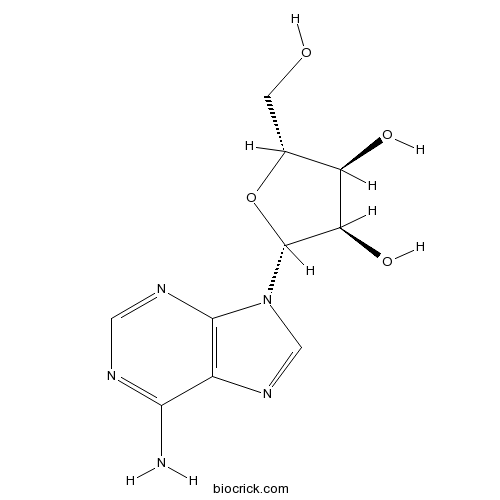
|
58-61-7 | COA |
| BCN5979 |
Caffeic acid
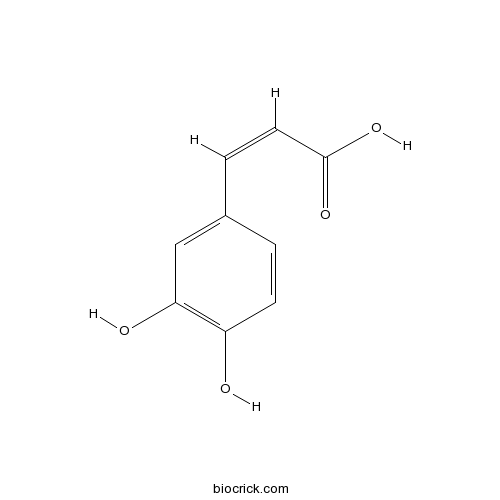
|
331-39-5 | COA |
| BCN5906 |
Chlorogenic acid
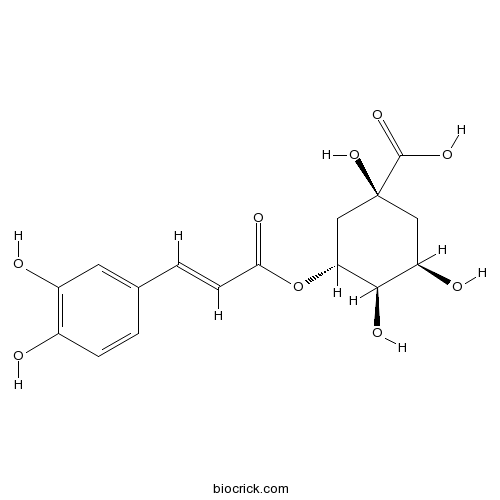
|
327-97-9 | COA |
| BCN5570 |
Hyperoside
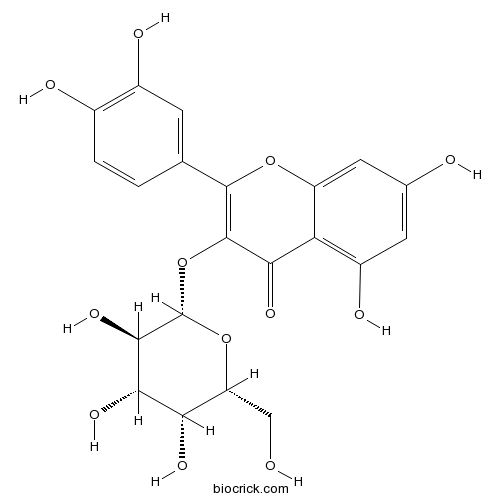
|
482-36-0 | COA |
| BCN1684 |
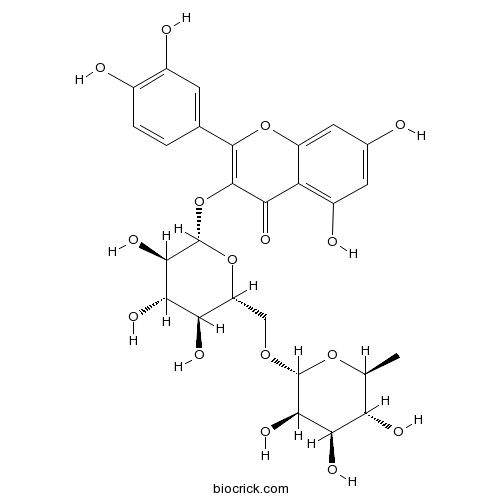
Rutin
|
153-18-4 | COA |
| BCN2770 |
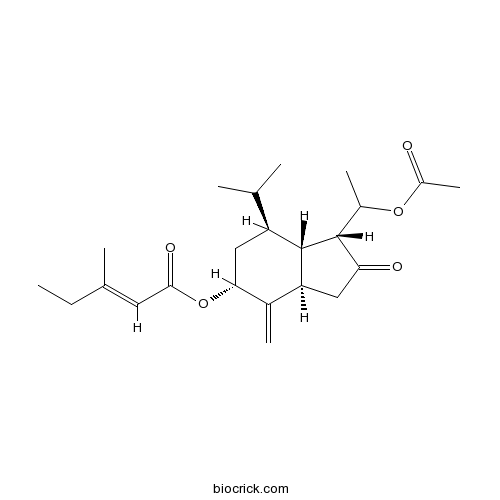
Tussilagone
|
104012-37-5 | COA |
References
Effects of Flower Buds Extract of Tussilago farfara on Focal Cerebral Ischemia in Rats and Inflammatory Response in BV2 Microglia.[Pubmed: 30090976]
To investigate the effects of the flower buds extract of Tussilago farfara Linné (Farfarae Flos; FF) on focal cerebral ischemia through regulation of inflammatory responses in activated microglia.
Biologically-active compounds from two members of the Asteraceae family: Tragopogon dubius Scop. and Tussilago farfara L.[Pubmed: 30058457]
Tragopogon dubius and Tussilago farfara are consumed as vegetables and used in folk medicine to manage common diseases. Herein, the chemical compositions and biological activities of different leaf extracts (ethyl acetate, methanol, and water) of T. dubius and T. farfara were evaluated. The antibacterial, antifungal, and antioxidant abilities of the extracts were tested using different assays including free radical scavenging, reducing power, phosphomolybdenum, and metal chelating assays. Enzyme inhibitory potentials were evaluated against cholinesterases, tyrosinase, α-amylase and α-glucosidase. Complexes of bioactive compounds (chlorogenic and rosmarinic acid) were docked into the enzymatic cavity of α-glucosidase and subjected to molecular dynamic calculation, enzyme conformational stability, and flexibility analysis. T. dubius and T. farfara extracts showed remarkable antioxidant potentials. Ethyl acetate extracts of T. dubius and T. farfara were the most potent inhibitors of acetylcholinesterase and butyrylcholinesterase. T. dubius ethyl acetate extract and T. farfara methanolic extract showed noteworthy activity against α-glucosidase. High performance liquid chromatography analysis revealed the abundance of some phenolic compounds including chlorogenic and rosmarinic acids. Ethyl acetate extract of T. dubius showed notable antifungal activity against all strains. Docking studies showed best pose for chlorogenic acid was stabilized by a network of hydrogen bonds with residues Asp1157, Asp1279, whereas rosmarinic acid showed several hydrogen bonds with Asp1157, Asp1420, Asp1526, Lys1460, and Trp1369. This study further validates the use of T. dubius and T. farfara in traditional medicine, as well as act as a stimulus for further studies for future biomedicine development.
Neuroprotection against 6-OHDA toxicity in PC12 cells and mice through the Nrf2 pathway by a sesquiterpenoid from Tussilago farfara.[Pubmed: 29890337]
None
Toxicity of plant extracts containing pyrrolizidine alkaloids using alternative invertebrate models.[Pubmed: 29620235]
Pyrrolizidine alkaloids (PAs) are a widespread class of hepatotoxic heterocyclic organic compounds found in approximately 3% of world flora. Some PAs have been shown to have genotoxic and carcinogenic effects. The present study focuses on the toxicity effects of four dry extracts obtained from medicinal plants (Senecio vernalis, Symphytum officinale, Petasites hybridus and Tussilago farfara), on two aquatic organisms, Artemia salina and Daphnia magna, and the correlation with their PAs content. A new GC‑MS method, using a retention time (TR)‑5MS type capillary column was developed. PAs Kovats retention indices, for this type of column were computed for the first time. The lethal dose 50% (LC50) values for the two invertebrate models were correlated (Pearson 's coefficient, >0.9) and the toxicity was PA concentration-dependent, for three of the four extracts. All tested extracts were found to be toxic in both aquatic organism models. The results can be used to develop a GC‑MS validated method for the assay of PAs in medicinal plants with a further potential application in the risk assessment study of PAs toxicity in humans.
Structural characterization of a polysaccharide from the flower buds of Tussilago farfara, and its effect on proliferation and apoptosis of A549 human non-small lung cancer cell line.[Pubmed: 29505876]
None
[Tissue culture of callus and establishment of regeneration system of Tussilago farfara petiole].[Pubmed: 29243424]
Young petiole of Tussilago farfara was used as the material to investigate the plant growth regulators which could influence in vitro culture and plant regeneration and to establish rapid propagation technique. The ideal sterilization method was that young petiole of T. farfara was sterilized with 75% ethanol for 30 s, and then transferred to saturated bleaching power supernatant for 15 min. The suitable medium for callus induction was MS+6-BA 3.0 mg•L⁻¹+2,4-D 2.0 mg•L⁻¹ with 96.2% induction rate. The seedlings had better differentiation with 91% differentiation rate and 8.26 buds on the medium containing MS+ZT 2.0 mg•L⁻¹+NAA 0.3 mg•L⁻¹. The preferred enrichment medium of adventitious bud was MS+KT 1.0 mg•L⁻¹+IBA 0.3 mg•L⁻¹ with 11.81 enrichment times and 4.9 cm seedling height. The rooting medium included 1/2MS+IBA 0.2 mg•L⁻¹ with the average number of rooting was 5.86 and the rooting rate was above 95.22%. The container seedlings can grow well and the survival rate was more than 90% when they were transplanted on the medium added with river sand and organic fertilizer with the ratio of 3∶1. The field experiments indicated that significant differences in increment and yield of pollen grains among the tissue-culture, cultivation and wild type of T. farfara under the same cultivation conditions. The cultivated plants were relatively high on the increment and yield of pollen grains. The active ingredient content of the tissue culture and the wild materials was basically the same.